
September 2024
TAPESTRY FROM ALLOWAY REACHES SOUTH AMERICA
In a reverse Paddington move, the work of one of our spinning volunteers from Robert Burns Birthplace Museum has been featured on the cover of the South American cultural magazine ‘Aleph’ (the first letter of the Hebrew alphabet) which publishes articles in art, literature and philosophy.
Ana María González was so inspired by a photo of a sunset at Manizales in Colombia taken by Aleph editor-in chief, Professor Carlos Enrique Ruiz, that she spun and wove a tapestry. He, in his turn, was so impressed by her creation that he published it in the very next edition.

August 2024
SPINNING AND SINGING
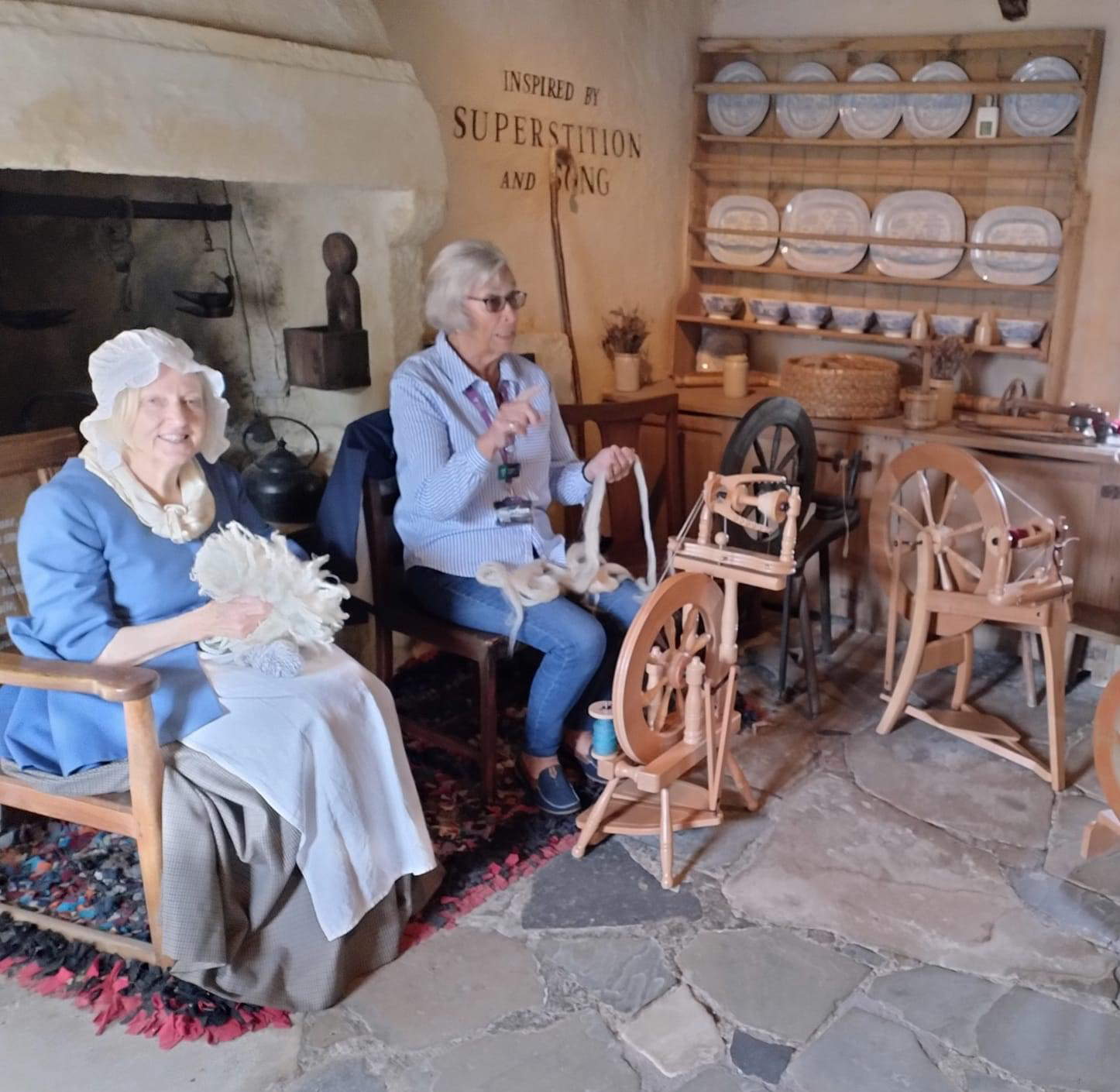
A group of visitors were very, very surprised – not to say shocked – that we weren’t singing to our spinning. Certainly, the two seem to have gone together traditionally.
Robert Burns wrote the words for a song about a woman spinning, Bessy and her Spinnin Wheel. It was to be sung to the tune of Sweet’s the lass that loves me. Bessy says: “I’ll sit me down, and sing and spin.”
She works outside in the sunshine and loves the trees, the pool and running water, and especially the birds around her. It brings her peace and pleasure. Today some ask us if it’s therapeutic.
Burns, in the eighteenth century, focuses also on the economic independence the spinning wheel brings women. It feeds Bessy and clothes her well, meeting all her modest needs.
Here’s how the poem starts:
O, leeze me on my spinning wheel Blessings
And leeze me on my rock and reel, Spindle and bobbin
From tap to tae that clads me bien, Clothes me nicely
And haps me fiel and warm at e’en Wraps me well
I’ll set me down, and sing and spin,
While laigh descends the summer sun, Low
Blest wi content, and milk and meal –
O, leeze me on my spinnin wheel
July 2024
VISITOR WALKS AYRSHIRE COASTAL PATH
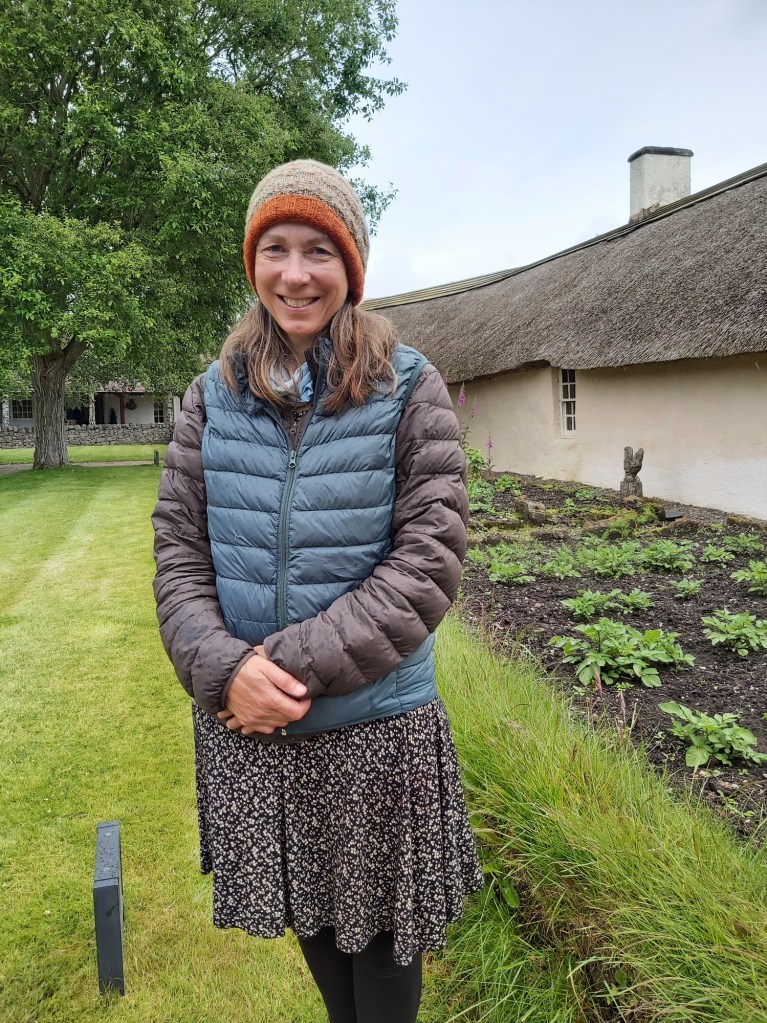
Writer and storyteller Anna Greenwood from Yorkshire took a diversion from Ayrshire Coastal Path to visit Burns Cottage and Robert Burns Birthplace Museum. This was part of a project recording conversations with folk about spinning and weaving. Of course, we were delighted to oblige!
She was specially interested to see Robert Burns’ darned sock in the museum and to note the darn had been darned, several times over!
Of great interest to us, and to others around as well, was the special trailer on which she packed her camping equipment. She attached it to herself with a harness.

See more at: www.annagreenwoodwrites.com
29 May 2024
A REMARKABLE DARN STORY
Just three or four weeks ago, with remarkable prescience, a visitor told us about how he darned his socks during his National Service. Born in March 1939 he was part of the last cohort to be called up. He served in North Africa and no doubt the properties of wool in absorbing sweat would help protect his feet from chafing and blisters.
22 May 2024
The Burns replica socks on our demonstration table have been attracting a lot of attention lately. Two volunteers in the group created them – one spun the green and buff wool and one knitted them.

They imitate the socks belonging to Robert Burns that are displayed in the museum. They’re size 9, darned and the darn is even darned, several times over.

An American lady and four ladies from Larkhall Women’s Guild had a lively conversation about darning techniques using a “mushroom”. One lady showed over her hand how the wool had to make a grid one way and then the wool was woven in and out at right angles. Some mushrooms had a cavity in the “stalk” to keep the darning needle safe and always at hand.
”The mother, wi’ her needle and her sheers,
Gars auld claes look amaist as weel’s the new.”
The Cotter’s Saturday Night
Another example of how Robert Burns still creates bonding across continents!
10 May 2024
A young woman from Northern Ireland was telling us about her granny’s spinning, a major activity that dominated the household for months. It all started with the grandpa shearing the sheep. Next, the children (the woman and her brother) would be sent out with scissors, a pair of gloves each and a basket. Their instructions were to cut nettles right down at the root and bring them home to be used for dyeing the wool. Wool and nettles were then boiled together in a big pot. Next day it was put into a shed for a week. Once Granny had spun all her wool she would set about the mammoth task of knitting blankets!
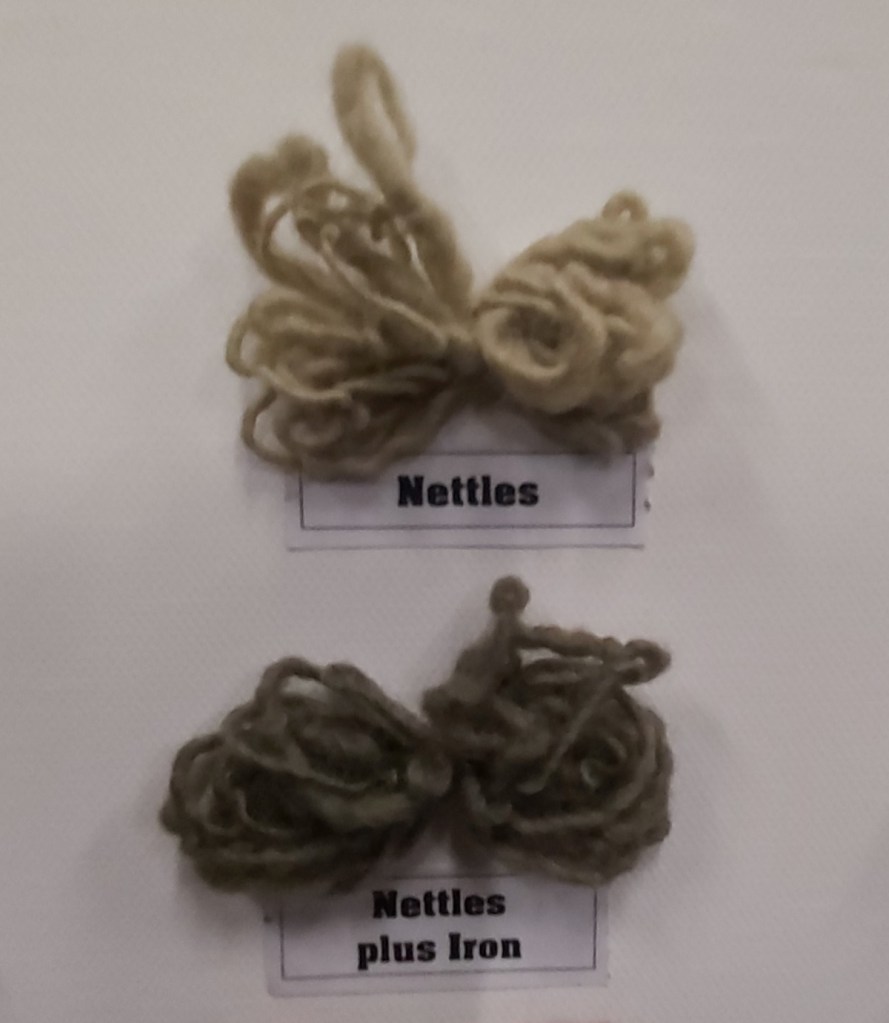
Come and see our Dyer-in-Chief’s display board. Here’s the result of her experiment with nettles (though she didn’t leave her pot in a shed for a week). We’re in the Temporary Gallery at Robert Burns Birthplace Museum, Murdoch’s Lone, Alloway every Thursday from 11am till 1pm.
April 2024
The biggest recorded number of visitors, 47, dropped in on the Spinning Group this week. We were kept busy showing the work that Agnes Burn, Robert Burns’ mother, would have done in the cottage when he was a boy.

Many of the visitors were American and one lady from Louisiana told us that she had in her family a pair of carders dating back to her Grandaddy’s time when he was a cotton farmer.
 Friends of Robert Burns Birthplace Museum